

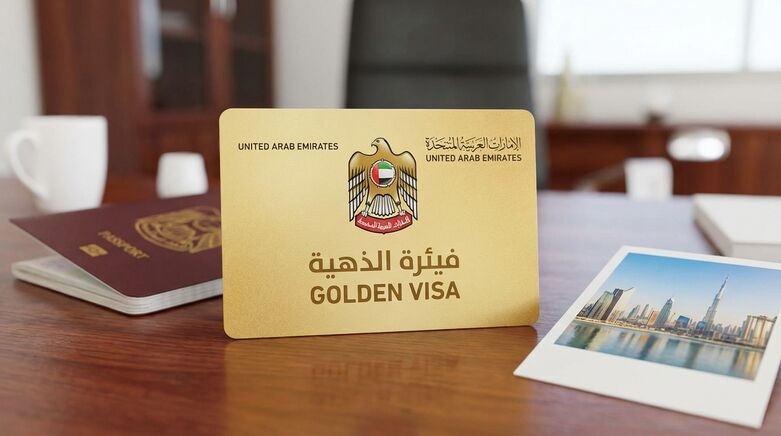
Dubai Golden Visa Through Property: 2026 Requirements
The Dubai Golden Visa through property is a ten-year, renewable residence permit. It is granted to foreign nationals who own UAE real estate with a registered value of AED 2 million or more. The permit is issued by the Federal Authority for Identity, Citizenship, Customs, and Port Security (ICP). For real estate investors, it is administered by the Dubai Land Department (DLD). The program does not require a local sponsor, employer affiliation, or a minimum period of physical residence in the United Arab Emirates. In 2026, the AED 2 million qualifying threshold remains unchanged. A regulatory reform introduced in February 2026 has widened access by removing the previous upfront payment requirement.
This guide sets out the precise 2026 eligibility requirements. It describes the categories of property that qualify, the documents an applicant must submit, the application process managed by the Dubai Land Department, the government costs, and the benefits the visa confers.
What Is the Dubai Golden Visa Through Property?
The Dubai Golden Visa through property is a residency-by-investment instrument. It allows a qualifying real estate holding to be converted into long-term, self-sponsored residence in the UAE. Because the status is self-sponsored, the holder is not tied to any employer. The holder may change occupation, establish a company, or own a business on the Dubai Mainland or in any Free Zone. Critically, the residence remains valid even if the holder spends more than six consecutive months outside the UAE. This provision distinguishes the Golden Visa from standard residence permits, which are automatically canceled after a continuous absence of that length.
The property route is one of three residency pathways in Dubai linked to real estate ownership. The other two are the two-year property investor visa and the five-year retirement visa. Of these, the Golden Visa offers the longest validity, the greatest family sponsorship rights, and the greatest flexibility. This is why it remains the preferred option for high-net-worth and internationally mobile investors.
What Are the 2026 Requirements for the Dubai Golden Visa Through Property?
The 2026 requirements rest on four conditions that each applicant must meet. The property must have a minimum registered value of AED 2 million, be within a designated freehold zone, be owned in the applicant’s name, and have its value certified by the Dubai Land Department. Failure to meet any condition results in rejection, so each detail needs careful attention. Investors can compare properties currently on the market in the UAE to find freehold homes that meet the AED 2 million threshold.
The AED 2 Million Investment Threshold
The minimum qualifying investment is AED 2 million, about USD 545,000. The Dubai Land Department bases its eligibility checks on the purchase price on the title deed, not on market valuation, the amount paid so far, or private appraisals. An applicant can reach the threshold with a single asset or by combining several properties. Investors aged fifty-five and over may instead qualify for a five-year residence permit with property valued at AED 1 million. This is a separate category from the ten-year Golden Visa.
The Freehold Zone Condition
The property must be in a designated freehold area where foreign ownership is allowed. Assets in leasehold or non-freehold districts of Dubai are excluded, as are properties in other emirates like Abu Dhabi, Sharjah, or Ras Al Khaimah. Each emirate has its own residency-by-investment framework. Properties registered outside Dubai cannot be credited toward a Dubai Golden Visa application.
Eligible Property Categories
Completed (ready) properties, off-plan units, and mortgaged properties all qualify in 2026 if they meet the AED 2 million threshold. Off-plan purchases must be made through a licensed developer and supported by an Oqood certificate. Mortgaged properties need a no-objection certificate (NOC) from the bank, confirming the amount paid, the outstanding balance, and consent for the residence permit.
The February 2026 Regulatory Reform
The main change in 2026 is the removal of the mandatory upfront payment requirement. Before, applicants had to show that at least 50 percent of the property value, or a minimum of AED 1 million, had been paid. Since February 2026, eligibility has depended only on the registered property value reaching AED 2 million. The outstanding mortgage balance or payment plan structure no longer matters. This reform extends the Golden Visa to more off-plan purchasers who were previously ineligible but are committed to the market.
How Does the Dubai Golden Visa Application Process Work?
The Dubai Land Department administers the application process for property investors. It verifies ownership, confirms that the value threshold is met, and submits the residency nomination to the ICP. The DLD route is the most efficient because it combines verification and submission. This means applicants do not need to coordinate separately with the General Directorate of Residency and Foreigners Affairs (GDRFA) or the ICP. Applicants wanting support can work with real estate agents in the UAE to manage the purchase and DLD submission.
The procedure proceeds through six sequential stages:
- Confirm eligibility. Check that the title deed value, or the combined value of your portfolio, is at least AED 2 million. Make sure every asset is in a designated freehold zone. Investors may pre-validate their properties through the Dubai REST app using UAE Pass credentials.
- Obtain a property status statement. Request a property status statement certificate, also known as a valuation certificate, from the Dubai Land Department. This document confirms your ownership and the property value.
- Submit the application and pay the fees. Apply in person at a DLD Golden Visa Service Center, or digitally on the Dubai REST app and the DLD Cube platform. Pay the required government and service charges.
- Complete the medical fitness examination. Undergo the required medical examination at an approved health center.
- Process the Emirates ID. Provide biometric data to obtain the ten-year Emirates ID.
- Receive the Golden Visa. Once all verifications are complete, the residence permit is issued and emailed to the applicant.
After the visa is issued, a lien is registered against the qualifying property. This ensures continuity of ownership for the Golden Residency period. The property cannot be sold or transferred until the linked visa status is formally addressed.
After outlining the steps, attention should turn to the documentation necessary for a successful application.
A property-based application requires a valid passport and the electronic title deed or, for off-plan units, the Oqood certificate. You must also provide a recent personal photo that meets ICP specifications, a copy of your UAE residence permit, and proof of valid health insurance. If the property is mortgaged, supply a bank NOC confirming the paid and outstanding amounts.
Applicants sponsoring dependents must provide additional documents. These include a certified marriage contract for a spouse, certified birth certificates for children, the sponsor’s original passport and ID, and an undertaking that adult children are unmarried. Include an IBAN number and, if the mother is the sponsor, a notarised no-objection letter from the father.
With the application documents identified, the next concern for applicants is understanding the associated costs.
In 2026, the total government cost for the primary applicant is about AED 6,720. The main charges are a medical exam fee of AED 700, a ten-year Emirates ID fee of AED 1,153, and a residency confirmation fee of AED 2,856.75. There are also DLD nomination and ICA processing charges.
Standard processing takes two to four weeks from submission to visa stamping. The Dubai Land Department offers a premium service, costing about AED 1,000 to AED 2,000 more, that reduces the process to under ten business days. This is useful for applicants with short-validity entry permits. Sponsoring a dependent adds AED 2,000 to AED 3,000 each. The most common cause of delay is document inconsistencies, such as different name spellings across documents like the passport and title deed.
Price disclaimer: All fees quoted above are indicative 2026 figures and are subject to change by the Dubai Land Department, RERA, the ICP, and other competent authorities. Confirm the current schedule of charges through official government channels before applying.
Finally, appreciating the benefits that accompany the property Golden Visa enables applicants to measure the value this permit can bring.
The property Golden Visa confers ten years of renewable, self-sponsored residence with no minimum-stay obligation. The holder may sponsor a spouse, children of any age, parents, and domestic staff for the full term of the permit. The status permits full business ownership in both the Mainland and the Free Zones and allows employment with any organization without the need to obtain a separate residence permit.
Beyond mobility, UAE financial institutions regard Golden Visa holders as low-risk, high-net-worth clients, which streamlines the opening of bank accounts and the approval of mortgage facilities. Eligible holders resident in Dubai may also obtain the Esaad privilege card, which provides preferential rates across hotels, restaurants, educational institutions, and healthcare providers.
How Does the Golden Visa Differ From the Two-Year Investor Visa?
The Golden Visa and the two-year property investor visa are separate instruments with distinct thresholds. The Golden Visa requires AED 2 million in registered property value and grants a ten-year renewable residence. The two-year investor visa, administered through the DLD Taskeen service, was revised in April 2026: sole owners of any completed residential property now qualify regardless of value, while joint owners must each hold a registered share of at least AED 400,000. The AED 400,000 figure should not be confused with the Golden Visa threshold, which applies solely to the shorter two-year route.
Frequently Asked Questions
What is the minimum property value for the Dubai Golden Visa in 2026?
The minimum qualifying value is AED 2 million (approximately USD 545,000), assessed on the purchase price recorded on the title deed. The threshold can be met with a single property or a combined portfolio of several properties.
Can I obtain a Golden Visa with a mortgaged or off-plan property?
Yes. Following the February 2026 reform, mortgaged and off-plan properties qualify, provided the total registered value is at least AED 2 million. Mortgaged properties require a no-objection certificate from the financing bank, and off-plan units require a valid Oqood certificate from an approved developer.
Is there a minimum stay requirement to keep the Golden Visa valid?
No. Unlike standard UAE residence permits, the Golden Visa remains valid even if the holder spends more than six consecutive months outside the UAE.
How long does the Golden Visa application take?
Standard processing through the Dubai Land Department takes approximately two to four weeks. A premium service can reduce this to under ten business days for an additional fee.
Can I sponsor my family on a property Golden Visa?
Yes. The holder may sponsor a spouse, children of any age, parents, and domestic staff for the full ten-year term, subject to additional per-dependant fees.
What happens at renewal if my property value falls below AED 2 million?
The property must continue to satisfy the AED 2 million threshold at the point of renewal. Acquiring assets in established, high-demand freehold communities helps protect both residency status and capital value.
Ready to Invest in a Golden Visa–Eligible Dubai Property?
If you are considering Dubai real estate as a route to a ten-year UAE residence, the right freehold property is the foundation of a smooth Golden Visa application. Browse homes across Dubai’s leading freehold communities on Ziba Property and connect directly with Dubai-based agents who can help you identify a property that meets the AED 2 million threshold and guide you through the Dubai Land Department process from purchase to residency.

About the Author
Muhammad Amir is a Dubai-based real estate writer at Ziba Property, covering UAE residency pathways, freehold investment, and Dubai property market trends. His guides draw on current guidance from the Dubai Land Department, RERA, and ICP and are written to help international investors navigate the Dubai property market with clarity.

