


Properties for Sale in Kuala Lumpur 2026 Buyer’s Guide
Ask a few people in Kuala Lumpur (KL) where they would buy a home, and you will probably get very different answers. One may recommend Mont Kiara for its family-friendly condos, another may prefer Bangsar for its established neighborhood feel, while someone else may be looking at more affordable options in Setapak.
Those different opinions make sense: Kuala Lumpur is not a single, uniform property market. Each neighborhood has its own price range, lifestyle, buyer profile, and pace. If you are browsing properties for sale in Kuala Lumpur, this guide explains where the market stands as of October 2026, the main rules buyers should know, and the practical checks that help you avoid costly surprises.

Why Kuala Lumpur Still Appeals to Buyers in 2026
For a capital city, Kuala Lumpur can still offer a lot of space for the money. A budget that might only cover a small studio in Singapore or Hong Kong could buy a larger condominium in KL—sometimes a three-bedroom unit with facilities such as a swimming pool, gym, parking, and round-the-clock security.
That does not mean every property is a good buy. Buyers are comparing options more carefully, developers are taking a measured approach to new launches, and foreign buyers face higher upfront costs. Well-located homes in properly managed buildings tend to attract more interest, while properties in less convenient locations may take much longer to sell.
So the key question in 2026 is not simply whether you should buy in KL. It is which type of property suits your budget, plans, and preferred neighborhood.
Where the Kuala Lumpur Property Market Stands
The market is best described as steady rather than booming. Nationwide transactions weakened early in the year before settling, while interest rates remained stable and employment conditions supported demand.
| Indicator | Reported figure | Source |
|---|---|---|
| Malaysia transactions, first half of 2026 | 187,320 transactions worth RM105.12 billion | Bernama |
| Residential transactions, first half of 2026 | 110,998 transactions (59.3% of the total) | Bernama |
| Malaysia transactions, Q1 2026 | 89,966 transactions, down 8.0% year on year | New Straits Times |
| Overnight Policy Rate (OPR) | 2.75% | Bernama |
| KL average subsale price, Q1 2026 | About RM1.02 million, up roughly 15% year on year | Juwai IQI |
| Completed unsold homes in KL, Q1 2026 | 3,733 (32,801 nationwide) | NAPIC |
Note: These figures are based on published market reports and are indicative, not guaranteed current prices. Confirm current prices with a licensed real estate agent in Malaysia.
A few patterns stand out. Buyers are paying close attention to access to MRT and LRT stations, as well as the quality of building management. Consultants at CBRE | WTW expect price movements to vary by location and property type rather than rise evenly across the market.
Unsold stock is still worth watching. Kuala Lumpur’s count of completed but unsold homes rose in Q1 2026, and the nationwide total climbed to 33,094 units by the end of June. Well-located homes continue to sell, but in slower segments, buyers have more room to negotiate.
Construction costs are another factor to watch. A REHDA survey found that developers’ construction costs rose by an average of 13% between March and June 2026, and many developers have delayed launches as a result. This may make substantial price cuts on new projects less likely and could help support resale prices.
What Types of Property Can You Buy in KL?
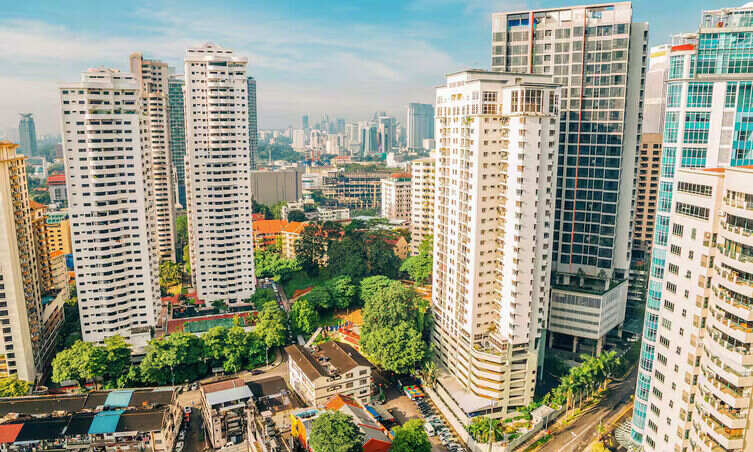
Land is limited within the Federal Territory, so many listings are for high-rise homes. Understanding the differences between property types will help you compare options fairly.

Condominiums
Condominiums are a common choice for families, professionals, and foreign buyers. They often offer controlled access, security, a swimming pool, a gym, and covered parking. You will find plenty of options in Mont Kiara, KLCC, and Bangsar.
Serviced Residences
Serviced residences (also called serviced apartments) are often built on commercial land, sometimes above a shopping center or near offices. Their asking prices per square foot may be lower than those of residential condominiums, but check the details carefully: maintenance fees and utility bills may be higher, and some banks may offer a smaller loan. Supply is also high. Kuala Lumpur had 4,181 completed but unsold serviced residences in Q1 2026, the second-highest figure in the country. NAPIC tracks these separately from residential homes, so they are not included in the 3,733 figure above.
Apartments and Flats
Older apartments and flats often have simpler facilities, but they can be more affordable. For first-time buyers looking in Setapak, Cheras, or Kepong, they may be a practical way to get onto the property ladder.
Landed Homes
Terrace houses, semi-detached homes, and bungalows are relatively scarce within KL and can command high prices. Buyers often look in established areas such as Bangsar, Damansara Heights, TTDI, and Desa ParkCity.
Commercial Units
Shop offices, office suites, SOHO (small office/home office), and SOFO (small office/flexible office) units come with different financing, tax, and tenancy considerations. Assess them as a business purchase rather than assuming the same rules as for a residential home.
Always check the property’s tenure. Freehold ownership has no expiry date, while leasehold properties commonly have a 99-year term. When a lease has less than around 60 years remaining, resale and financing can become more difficult.
Best Neighborhoods to Buy Property in Kuala Lumpur
The right area depends on how you live, where you work, your budget, and whether you plan to live in the property or rent it out.
KLCC and the Golden Triangle
This is central KL at its most recognizable, with the Petronas Towers, Bukit Bintang, Jalan Ampang, and the TRX financial district nearby. It suits buyers who want to live close to offices, restaurants, and city attractions, as well as investors targeting executive tenants.
Mont Kiara and Sri Hartamas
Mont Kiara and Sri Hartamas are popular with expatriate households, thanks to international schools, larger family condominiums, and a well-established social scene. Read our Mont Kiara homes for sale guide for a closer look at the area.
Bangsar and Bangsar South
Bangsar is known for its established residential streets, landed homes, cafés, and busy weekend atmosphere. Nearby Bangsar South has a more modern mix of offices and residential developments, and offers access to the LRT.
Damansara Heights and TTDI
These neighborhoods are greener, quieter, and generally more upmarket. Families looking for landed homes often consider either area, and each has access to the MRT Kajang Line.
Desa ParkCity
Desa ParkCity is a planned township centered around a large park, with a strong community atmosphere. Prices can be high for a suburban location, but the setting and amenities appeal to residents who want to settle in one place for the long term.
Bukit Jalil
Once best known for the National Stadium, Bukit Jalil has grown into a busy mid-market residential area. Pavilion Bukit Jalil and newer condominiums near the LRT are among its key attractions.
Cheras, Setapak, and Sentul
These areas are worth exploring if you are working with a tighter budget. Cheras and Setapak have a range of relatively affordable homes, while Sentul has been changing with new developments and parks not far from the city center. Our Prima Setapak Condominium review offers an example of the local market.
Kepong and Segambut
Kepong and Segambut can be practical choices for families looking for mid-range condominiums. Rail connections are improving, and the areas are sometimes overlooked by buyers who focus only on the best-known central neighborhoods.
What Your Budget May Buy: KL Property Prices by Area
Prices can vary considerably between neighborhoods—and even between units in the same building. Use the figures below as a broad guide rather than a formal valuation.
| Area | Approx. condo price per sq ft | Typical starting price | May suit |
|---|---|---|---|
| KLCC / Golden Triangle | RM1,500–RM3,000+ | RM1.2 million+ | Luxury buyers and investors |
| Damansara Heights / Bangsar | RM900–RM1,500 | RM1 million+ | Families and upgraders |
| Mont Kiara / Sri Hartamas | RM700–RM1,100 | RM800,000+ | Expatriate families |
| Bukit Jalil / Sentul | RM550–RM850 | RM500,000+ | Young professionals |
| Cheras / Setapak / Kepong | RM400–RM600 | RM350,000+ | First-time buyers |
Note: These are approximate asking-price ranges based on general market observations, not official figures. Actual prices depend on the building, floor, condition, and timing. Confirm current prices with a licensed real estate agent in Malaysia.
Remember to budget for more than the advertised price. Malaysian buyers are generally advised to allow roughly 3% to 5% on top of a 10% deposit for items such as legal fees, stamp duty, valuation, and loan-related costs. Foreign cash buyers may need to budget around 10% to 11% in additional costs once the higher stamp duty is included.
Developers do not always reduce the advertised price of a new launch. Instead, they may offer rebates, legal-fee packages, or furniture. With a subsale property, you negotiate directly with the owner, so there may be more room to negotiate the price itself.
Buying Property in KL as a Foreigner: 2026 Rules
Foreigners can buy property in Kuala Lumpur, and ownership can be registered in their names. However, upfront costs are higher in 2026. Here are the key points to know:
- Minimum purchase price: RM1 million for condos and landed homes in KL. Thresholds differ by state, and some states, including Selangor, set higher limits.
- Stamp duty: From 1 January 2026, foreign buyers pay a flat 8% stamp duty on residential property transfers, up from 4%. It is charged on the purchase price or the market value, whichever is higher, so on a RM1 million home it amounts to at least RM80,000. Malaysian permanent residents are not subject to this rate.
- State consent: Approval from the relevant state authority is required before the transfer can be completed. Allow extra time for this step.
- Restricted properties: Low- and medium-cost housing, Bumiputera lots, and Malay Reserve land are generally not available to foreign buyers.
Note: Price thresholds and cost examples are indicative and based on rules available as of October 2026. Confirm current prices and requirements with a licensed real estate agent in Malaysia.
Malaysian banks may provide mortgages to non-residents, often financing around 60% to 70% of the property value, depending on the applicant and the property. Getting an approval in principle before making an offer can help you understand your budget.
If residency is also part of your plans, review the current Malaysia My Second Home (MM2H) requirements. The Silver tier requires a USD150,000 fixed deposit and a home worth at least RM600,000, and MM2H homes generally cannot be resold for 10 years. In Kuala Lumpur, however, the RM1 million minimum for foreign buyers still applies. Confirm the current requirements with the relevant authorities and a qualified adviser, and confirm current property prices with a licensed real estate agent in Malaysia.
The higher stamp duty has reportedly made some foreign buyers more cautious, but it has not necessarily removed their interest in Malaysia. Even at 8%, Malaysia’s rate remains well below the Additional Buyer’s Stamp Duty (ABSD) that foreigners pay in Singapore. These rules can change, so check the latest official requirements before relying on a comparison.
Buying Property in KL as a Malaysian: Incentives and Home Loans
Malaysian buyers generally face lower entry costs, and first-time buyers may qualify for helpful exemptions. If you are buying your first home, read our guide to what first-time home buyers in Malaysia should know before you begin viewing properties.
Malaysian first-time buyers currently receive a full stamp-duty exemption on both the property transfer and the loan agreement for homes priced up to RM500,000. Budget 2027, tabled on 9 October 2026, proposes keeping this exemption for sale and purchase agreements signed from 1 January 2027 to 31 December 2030, and adding partial relief for homes priced up to RM750,000: a full exemption on the first RM500,000 and 50% off the duty on the balance. The proposal takes effect only once it is gazetted, so confirm your eligibility and the final rules before relying on it.
For purchases that do not qualify for an exemption, the standard transfer stamp-duty tiers are 1% on the first RM100,000, 2% on the next RM400,000, 3% on the next RM500,000, and 4% on any amount above RM1 million. The loan agreement attracts a further 0.5%.
Banks may finance up to 90% of the purchase price for a buyer’s first two homes, with loan terms extending up to 35 years or until the borrower turns 70, subject to the bank’s criteria. Bank Negara Malaysia has held the OPR at 2.75% since July 2025, but loan packages still differ, so compare lock-in periods and early-settlement charges carefully.
Before paying a booking fee, check your CCRIS and CTOS credit reports and seek loan pre-approval. Banks commonly assess total monthly debt against income, often capping it at around 60% to 70% of net income. Knowing your borrowing limit early can prevent disappointment later.
You may also want to check whether you qualify for RUMAWIP, the Federal Territory’s affordable housing scheme, before focusing only on open-market properties.
How to Buy Property in Kuala Lumpur, Step by Step
A typical subsale purchase in Kuala Lumpur may take three to six months from offer to key collection. Foreign buyers may need longer because state consent can add time. Deposits and timelines vary by transaction, so confirm the terms with your lawyer. Our step-by-step guide to buying property in Malaysia explains the process in more detail.
- Set your budget. Include deposits, legal fees, stamp duty, and other costs, and obtain loan pre-approval.
- View the property carefully. Visit at different times of day, inspect the lifts and car park, and compare recent sale prices for similar units in the same building.
- Make an offer. You will usually sign a Letter of Offer and pay an earnest deposit, commonly around 2% to 3% of the purchase price.
- Appoint your own lawyer. Your lawyer can check the title, look for registered charges, and prepare the Sale and Purchase Agreement (SPA).
- Sign the SPA. The deposit is generally topped up to 10%. Completion often takes three months, with a possible one-month extension.
- Arrange financing. The bank values the property and prepares the loan agreement.
- Obtain any required consent. Foreign buyers and certain leasehold purchases may need state approval before the transfer can proceed.
- Pay the relevant stamp duty and complete the transaction. The loan is released, the seller receives payment, and ownership is transferred.
- Collect the keys. Arrange utility transfers and register with the building’s management office.
New-launch purchases follow a different schedule. Buyers usually pay a booking fee, sign the SPA with the developer, and make staged payments as construction progresses. Before signing, research the developer’s previous projects and check that the project has the required Housing Development Account.
What Could Influence KL Property Prices Over the Next Decade?
Transport links are an important factor in Kuala Lumpur’s property market. One project buyers are watching is the MRT3 Circle Line.
The MRT3 is planned as a 51.6 km loop around the city, with 10 interchange and connecting stations. Land acquisition is underway in 2026, construction is expected to begin in 2027, and the line is scheduled to be fully operational by 2032. Areas near proposed stations, including Titiwangsa, Setapak, Sri Hartamas, Bukit Kiara, and Pandan Indah, could benefit if the plans progress. However, major transport projects can be delayed, so choose a home that meets your needs today rather than relying only on future infrastructure.
The LRT3 Shah Alam Line began passenger service on 29 June 2026, linking Petaling Jaya, Shah Alam, and Klang to the wider Klang Valley rail network.
In central KL, TRX and Merdeka 118 continue to add to the city’s business profile and may support demand from corporate tenants for nearby homes.
Broader economic conditions matter as well. The 13th Malaysia Plan for 2026–2030, low unemployment, and rising wages are generally seen as supportive of housing demand. Occupancy of purpose-built offices also rose to 78.5% in the first half of 2026, according to the Finance Ministry.
Common Buying Mistakes—and How to Avoid Them
A little research before you commit can prevent many of the problems buyers encounter. Keep these checks on your list:
- Do not assume the asking price is the market value. Listings can be optimistic, so compare recent completed transactions in the same building.
- Check the actual walk to public transport. Visit the route yourself; a station described as nearby may feel less convenient in Kuala Lumpur’s midday heat.
- Look into building management. Ask about maintenance charges, the sinking fund, and unpaid fees. Poor management can affect residents’ experience and a property’s appeal.
- Check rental competition before investing. Some serviced-residence buildings have many similar units competing for tenants. Review the number of available rentals in the same development.
- Verify the title before paying a deposit. Confirm the tenure, title type, and any Bumiputera or land-use restrictions.
- Be realistic about rental income. Gross yields in KL are often in the low-to-mid single digits, and maintenance, vacant periods, and taxes reduce what you keep.
- Plan your eventual sale. Real Property Gains Tax may apply, and the amount can depend on how long you have owned the property and your status. Read our guide to the costs and fees of selling a house in Malaysia.
- Choose qualified professionals. Work with agents registered with the Board of Valuers, Appraisers, Estate Agents and Property Managers (BOVAEP), and appoint your own lawyer. Our guide explains how to find a reliable property agent in Malaysia.
Frequently Asked Questions
Is 2026 a good time to buy property in Kuala Lumpur?
It can be a reasonable time to buy a well-located home if the price and monthly payments fit your budget. Interest rates have been stable, and with completed but unsold homes rising nationwide, buyers in slower segments may have room to negotiate.
What is the average price of a home in Kuala Lumpur?
According to Juwai IQI, the average KL subsale price was about RM1.02 million in Q1 2026. Prime neighborhoods pull that average up, and homes below RM500,000 can still be found in areas such as Cheras, Setapak, and Kepong. Prices are indicative; confirm current figures with a licensed real estate agent in Malaysia.
What is the minimum property price for foreign buyers in KL?
The minimum for foreign buyers purchasing condos or landed homes in Kuala Lumpur is generally RM1 million, and foreign buyers pay a flat 8% stamp duty on the transfer of residential property. Check the latest official rules before making an offer.
Can foreigners get a home loan in Malaysia?
Yes. Banks may lend to foreign buyers, with financing often around 60% to 70% of the property’s value. The amount depends on the applicant’s income, documents, and the bank’s assessment.
Which Kuala Lumpur areas are popular with expatriates?
Mont Kiara, KLCC, and Bangsar are common choices because of their amenities, nearby international schools, and established expatriate communities.
Is freehold better than leasehold?
Freehold ownership has no expiry date, which many buyers value. Leasehold can still be a sensible choice if the price is appropriate and plenty of years remain on the lease. Banks generally want the remaining lease to comfortably outlast the loan term, and, as noted above, leases with less than around 60 years left can be harder to sell or finance.
Final Thoughts
Buying property in Kuala Lumpur in 2026 is about choosing carefully, not assuming the whole market will rise together. Homes with convenient transport access and reliable building management may be better placed to hold their appeal. Foreign buyers should plan for higher upfront costs, while eligible Malaysian first-time buyers may benefit from stamp-duty exemptions and available financing options.
Start with a realistic budget, shortlist two or three neighborhoods that fit your lifestyle, and compare asking prices with actual transactions. Take time to check the building, title, and professionals involved. With those basics covered, you will be in a much stronger position to find a home that suits your needs.
Start Your Kuala Lumpur Property Search
Ready to explore the market? Browse properties for sale in Malaysia on Ziba Property and narrow your search to Kuala Lumpur. Compare condominiums, serviced residences, and landed homes in areas such as Mont Kiara, Bangsar, Bukit Jalil, and Setapak. When a listing looks promising, contact a licensed real estate agent to arrange a viewing and confirm the property details.
Disclaimer
This article is for general information only and is not financial, legal, or investment advice. Figures and rules reflect information available as of October 2026. Property prices, taxes, and regulations in Malaysia can change. Before making a property decision, consult a licensed real estate agent in Malaysia, a qualified lawyer, or a financial adviser.

About the Author
Muhammad Amir writes about the Kuala Lumpur and Klang Valley property markets for home buyers, investors, and expatriates. He follows market reports, policy changes, and new developments across KL and Selangor, turning them into practical guides to help readers make more informed decisions about buying, renting, and selling property in Malaysia.

