Singapore Property Market Outlook 2026 & Forecast
Singapore’s property market enters the second half of 2026 with measured confidence. After several years of sharp post-pandemic price gains and aggressive cooling measures, the market has settled into what most research houses now call a “normalization phase”: prices are still rising, but at a pace that reflects genuine household demand rather than speculative momentum. This article breaks down what is happening across private residential, HDB resale, and rental segments, why it is happening, and what it means for buyers, upgraders, and investors planning a move in the next 12 to 24 months.
Price disclaimer: All figures in this article are indicative, drawn from published third-party research, and subject to change without notice. They do not constitute a valuation, quotation, or guarantee of future performance.
The Big Picture: A Market Finding Its Balance
Singapore’s economy is projected to grow between 2.0% and 4.0% in 2026, a resilient showing given ongoing global trade tensions and geopolitical uncertainty. That growth, combined with a labor market where unemployment remains at a historically low level of around 2.1%, provides the property market with a stable economic floor even as global headwinds persist.
The headline number that matters most: the URA Private Residential Property Price Index climbed to 208.8 in the first quarter of 2026, a 0.9% increase from the previous quarter. That’s not a dramatic jump — and that’s precisely the point. After 2025 closed with private home prices up 3.3% for the year, the slowest annual pace since 2020, the market is no longer accelerating. It’s consolidating around steadier demand.
Private Residential Price Forecast for 2026
If you’re asking the single most common question — will prices go up, flat, or down this year — the honest answer is that most major research desks converge on modest, single-digit growth rather than a dramatic move in either direction.
- CBRE and Cushman & Wakefield project growth in the 2% to 4% range
- OrangeTee/Realion forecasts 2.5% to 4.5%
- PropNex expects 3% to 4%
- ERA is slightly more bullish at 3% to 5%
The consensus centers on roughly 3% full-year growth in private residential prices, with a clear divergence between market segments. Non-landed homes in the Outside Central Region (OCR) are leading the pack, with some analysts citing OCR growth of up to 2.2% in a single quarter, while landed properties have posted stronger annual gains than the broader condo market. The Core Central Region (CCR), by contrast, continues to underperform, reinforcing the split already visible across the market.
Price disclaimer: The percentage ranges above are agency forecasts, not guaranteed outcomes. Actual price movements for any specific property will depend on unit-level factors including location, tenure, and condition.
Why the CCR Is Lagging
This isn’t a temporary blip — it’s structural. Foreign buyer participation in Singapore’s prime districts has not meaningfully recovered since the Additional Buyer’s Stamp Duty (ABSD) hikes took hold, and the government has given no signal that it intends to ease ABSD rates in the near term. With less foreign capital chasing prime units, CCR price growth is now driven almost entirely by local and permanent resident buyers, a smaller and more price-sensitive pool. Unless policy shifts, expect the CCR to continue trailing OCR and RCR (Rest of Central Region) through 2027, extending the same pattern seen elsewhere in the market. For a deeper breakdown of how ABSD affects different buyer profiles, see our ABSD and cooling measures guide.
HDB Resale Market: A Rare Pause
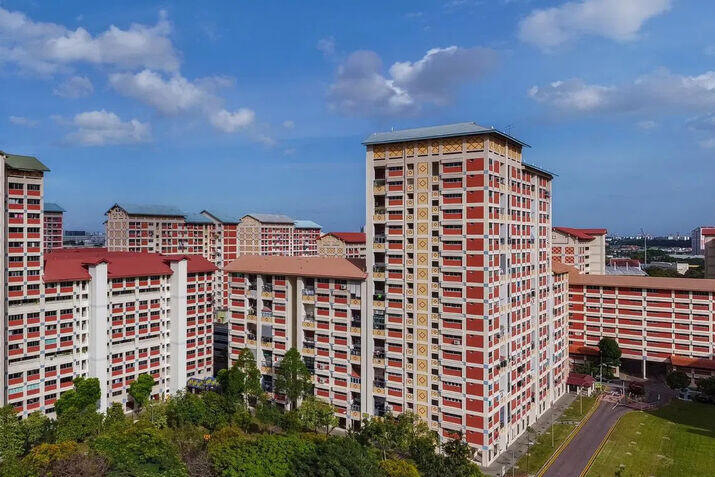
Public housing tells a different story this year. The HDB Resale Price Index actually dipped 0.10% quarter-on-quarter in Q1 2026 — the first quarterly decline since Q2 2019. Prices are still up 1.19% year-on-year, so this isn’t a crash by any means, but it does mark a genuine shift in momentum after years of relentless increases and a clearer pause in the market’s direction.
Interestingly, this softening at the index level masks a split within the HDB market itself. Even as the broader resale index cooled, the ultra-premium end of the public housing market — flats crossing the million-dollar mark — hit a record high in transaction volume during the same period. In short: the middle of the HDB market is cooling while the top end continues to defy gravity, driven by well-located, larger flats in mature estates.
For 2026 as a whole, most forecasters expect HDB resale prices to land somewhere between flat and a modest 2% gain, supported by CPF housing grants, household income growth, and steady family-formation demand — but without the double-digit exuberance seen in prior years. If you’re weighing a resale purchase against a new launch, it’s worth comparing what’s currently on the market browse Singapore Properties for sale .
Price disclaimer: HDB resale figures reflect index-level averages and may not represent price movement in any specific town, flat type, or block.
Interest Rates: The Quiet Tailwind
One of the most consequential — and underreported — shifts in 2026 has been the sharp decline in borrowing costs. The 3-month compounded SORA, the benchmark most floating-rate Singapore mortgages are pegged to, hovered near 1.0% in early 2026, down dramatically from a peak above 3% in early 2025. This rate shift matters because it feeds directly into affordability across the market.
This matters enormously for affordability. Lower SORA directly reduces monthly mortgage repayments and effectively increases the loan quantum a household can service under MAS’s Total Debt Servicing Ratio (TDSR) framework. For HDB upgraders sitting on strong resale proceeds, this is arguably the most favorable financing environment in several years — though it’s worth remembering that TDSR and Loan-to-Value (LTV) limits still cap how far any household can stretch, regardless of how cheap the rate looks today. Rates this low tend to be cyclical rather than permanent, so locking in a budget that can survive a future rate normalization remains sound practice.
Price disclaimer: Interest rate figures reflect published benchmark data as of early 2026 and are subject to change; they do not constitute financial advice or a guarantee of future borrowing costs.
Supply Pipeline: The Factor Most Buyers Overlook
Supply is the variable most likely to determine whether the optimistic or cautious price scenarios play out. URA data points to roughly 55,800 private residential units, including executive condominiums, expected to complete over the coming years, while the government has committed to releasing more than 25,000 new private homes through the Government Land Sales (GLS) program between 2025 and 2027. Together, these pipelines explain why supply is central to the market outlook.
At least five executive condominiums are expected to launch in 2026, including projects likely to draw strong interest from budget-conscious upgraders. If completions land broadly in line with current projections, supply should remain a stabilizing rather than destabilizing force. However, if a disproportionate volume of units reaches completion simultaneously, vacancy rates could tick up, and rental yields could compress — a scenario several analysts flag as the primary downside risk for 2026-2027, with price growth potentially stalling or dipping modestly (in the 0% to -3% range) in that specific scenario. The effect would likely differ by segment, with some areas facing more pressure than others.
Price disclaimer: Downside-scenario figures are illustrative projections based on current supply data, not forecasts of specific outcomes.
Rental Market: Broadly Flat, Not Falling
Rents for non-landed private residential units are expected to stay broadly flat in 2026. Vacancy rates remain below the 6.5% threshold that historically triggers softer rental growth, which should continue to support landlords even as expatriate demand has cooled somewhat. Leasing activity is increasingly being propped up by local households and permanent residents who need interim housing while their new-build homes are under construction — a demand source that tends to be more stable and less cyclical than expatriate relocation demand, helping keep the rental market aligned with the broader picture of stability.
Cooling Measures: Policy Continuity, Not Policy Change
Singapore’s property market remains one of the most actively and deliberately managed in the world, and 2026 has brought no signal of loosening. The ABSD framework, TDSR, MSR (Mortgage Servicing Ratio), and LTV limits are all expected to stay in place through the year. The government has repeatedly reiterated that households and buyers should exercise prudence when taking on new mortgage obligations, even in a lower-rate environment, which keeps policy aligned with the market’s measured tone.
This policy continuity is, in many ways, a feature rather than a bug for long-term market participants. It reduces the risk of the kind of speculative overheating that has historically triggered sudden, disruptive cooling measures — a predictability that both local buyers and institutional investors have come to value specifically in the Singapore market.
Investment Positioning: Precision Over Exuberance
Singapore continues to rank among the top investment destinations in the Asia-Pacific region in 2026, buoyed by its safe-haven status, transparent legal system, and political stability. But the theme for capital deployment this year is selectivity rather than broad-based buying, a message that carries through the rest of the market.
A few practical takeaways for anyone navigating this market:
- Upgraders with strong HDB sale proceeds are in a genuinely advantageous position right now, since elevated resale prices, combined with low SORA rates, reduce both the cash quantum required and the ongoing debt-servicing burden.
- OCR and RCR developments with strong transport connectivity are where most of the demand — and most of the realistic price growth — is concentrated.
- CCR investors should treat the segment as a longer-term wealth-preservation play rather than a short-term capital-appreciation bet, given the structural absence of foreign buying demand.
- New launches are being priced more realistically by developers this year, a shift from the aggressive pricing strategies of 2023-2024, which is itself a healthy sign for the market’s sustainability.
The Bottom Line
The Singapore property market in 2026 isn’t chasing headlines — and that’s the story. Private residential prices are on track for roughly 3% annual growth; HDB resale prices have hit a rare pause after years of gains; mortgage rates have fallen to multi-year lows; and supply is rising in a way that should keep the market balanced rather than tight. The risks — a potential supply glut, global economic slowdown, or unexpected policy shift — are real but manageable, and Singapore’s structural fundamentals (land scarcity, political stability, and its role as a regional wealth hub) continue to underpin the market’s long-term resilience.
For buyers and investors, 2026 rewards patience and fundamentals-driven decision-making over urgency. Neither runaway optimism nor deep pessimism fits the data — which, for a market that has swung between both extremes in recent years, is arguably the healthiest outcome of all.
Frequently Asked Questions
Will Singapore property prices rise or fall in 2026?
Most major agencies expect modest growth of roughly 2% to 5%, with a consensus around 3% for private residential prices. HDB resale prices are forecast to stay closer to flat, in the 0% to 2% range.
Which property segment offers the best growth potential in 2026?
The OCR (Outside Central Region) and RCR (Rest of Central Region) are currently leading price growth, supported by local demand and transport connectivity. The CCR (Core Central Region) is lagging due to weaker participation from foreign buyers under the current ABSD rules.
Are Singapore mortgage rates falling in 2026?
Yes. The 3-month compounded SORA has fallen to around 1.0% in early 2026, down from over 3% in early 2025, though TDSR and LTV limits still govern how much any household can borrow.
Will the government ease ABSD or other cooling measures in 2026?
There is no indication of near-term relaxation. The ABSD, TDSR, MSR, and LTV frameworks are all expected to remain unchanged through 2026, reflecting the government’s preference for policy stability over reactive adjustment.
Is 2026 a good time to buy or upgrade in Singapore?
For upgraders with strong HDB sale proceeds, current conditions — elevated resale prices paired with lower mortgage rates — are relatively favorable. However, all financing decisions should account for the possibility of future rate normalization and should factor in individual affordability limits under TDSR and MSR.
How many new private homes are expected to be completed in Singapore by 2027?
URA data indicates approximately 55,800 private residential units, including executive condominiums, are in the completion pipeline, alongside more than 25,000 new units planned through the GLS program between 2025 and 2027.
Ready to Explore Singapore’s 2026 Property Market?
Whether you’re an upgrader weighing HDB resale proceeds against a new launch, or an investor looking to position ahead of the next supply cycle, browse current Singapore new launch and resale listings on Ziba Property to see how today’s pricing and financing environment applies to your budget.

About the Author
Muhammad Amir is a Singapore property market writer at Ziba Property, covering private residential, HDB resale, and financing trends for local buyers, upgraders, and investors. His analysis draws on published data from URA, HDB, and MAS, as well as market commentary from CEA-registered property agencies, including CBRE, Cushman & Wakefield, PropNex, ERA, and OrangeTee/Realion. For guidance specific to your own purchase or sale, Muhammad recommends working directly with a CEA-registered property agent